It’s Saturday morning, and it’s Tyler’s tenth birthday.
He’s at the kitchen window in his pajamas, waiting for his mom.
Jen runs every Saturday. Three miles, back by eight. Then pancakes. That’s the deal, and on birthdays, the pancakes come with chocolate chips.
Jen is 51. She’s not overweight. She doesn’t smoke. She does the walking group, the salads, the yearly physical. Three months ago her doctor looked at her labs and said, “Your cholesterol’s fine.” Her LDL was 92.
Eight o’clock comes. Then 8:30.
Tyler asks his dad, “Did Mom get lost?”
At 9:10, his dad’s phone rings with a number he doesn’t recognize.
A woman walking her dog found Jen on the trail. The paramedics worked on her for forty minutes. Her heart had simply stopped. There was no chest pain the week before and no warning.
The chocolate chips are still sitting in the bag on the counter.
Tyler will turn eleven, and sixteen, and thirty. Every one of those birthdays will start with the morning his mom didn’t come home.
Across town that same morning, Emma is turning sixteen. Her dad promised her a driving lesson after his jog.
He never walked back through the door either.
His doctor had told him the same thing: “Your cholesterol looks fine.”
This isn’t rare
Researchers looked at about 137,000 people hospitalized for heart attacks. About half had an LDL under 100. That’s the number most of us are told is fine. (Sachdeva et al., American Heart Journal, 2009)
For a lot of people, the first symptom of heart disease is sudden death. The first sign is also the last one.
So how does “fine” cholesterol stop a healthy heart on a Saturday morning?
To answer that, you have to know what LDL actually is. It surprised me.
Your blood is a highway, and fat is the passenger
I’m an environmental engineer, so I think about this like a traffic system.
Your blood is mostly water. Fat and cholesterol don’t mix with water, so your body can’t just dump them into the bloodstream. It ships them in trucks called lipoproteins.
The main passenger in those trucks is fat.
There are two big trucks:
- Chylomicrons come from your gut. When you eat a meal, your gut loads that meal’s fat into them.
- VLDL comes from your liver. Your liver loads it with fat, including fat it makes from extra sugar and calories.
The trucks drive around your body dropping off passengers. Muscles take fat for fuel, and fat cells store some for later. As the trucks unload, they get smaller.
Here’s the part that stopped me cold.
When VLDL drops off most of its passengers, what’s left is LDL.
I always thought VLDL and LDL were two separate things. They aren’t. LDL is the same truck, just mostly emptied out, with cholesterol still on board.
Once I learned that, it made perfect sense. Why would your body build two separate delivery systems when one truck can do the whole route? It loads up, drops off fat, shrinks, and finishes as LDL. That’s efficient engineering.
It also means something that sounds almost too obvious:
- Every one of these particles carries fat.
- More fat needing a ride means more trucks on the road.
- More trucks leaving the liver means more LDL at the end of the route.
It’s the people who want to travel that make traffic. It’s the fat that needs transportation that makes LDL.
When the passengers have nowhere to go
The trucks themselves aren’t the problem. Your body needs them, because your cells use cholesterol to build cell walls, make hormones, and make the bile that digests your food.
The problem is too many passengers.
When you eat more fat and calories than your body needs, more big trucks go out. They pull up to your muscles, but your muscles are already full and say no. They pull up to your fat cells, which are filling up too. If you have insulin resistance, your cells say no even faster.
So the passengers have nowhere to go, and the trucks keep driving lap after lap.
Every lap through your arteries is another chance to hit the wall.
How a stuck truck becomes a heart attack
Some of those particles push into the wall of your artery, and they get stuck.
Trapped there, they get damaged. Your immune system sends cleanup cells, and those cells eat the particles until they’re bloated with fat. Doctors call them foam cells. When enough of them pile up, you have plaque.
Most heart attacks aren’t a pipe slowly clogging shut. They happen when a plaque cracks open. Your body treats the crack like a wound and forms a clot.
- If the clot blocks an artery in your heart, that’s a heart attack.
- If a clot blocks blood to your brain, that’s a stroke.
That’s what happened on those two Saturday mornings.
The blind spot: what your cholesterol test doesn’t count
So why did the labs say Jen was fine?
Think about what that LDL number on your lab report actually measures. It isn’t counting trucks. It measures how much cholesterol is riding in one kind of truck, the LDL kind.
It doesn’t directly count:
- The big VLDL trucks still out on their routes
- The chylomicrons from your last meal
- The leftovers
Those leftovers are the trucks that dropped off some passengers but not all of them. They’re half-empty VLDL and chylomicrons still circling. Scientists call them remnants.
The brand-new big trucks are often too large to slip into an artery wall. Remnants are small enough to get in. Particle for particle, they’re at least as good at building plaque as LDL. Large studies out of Copenhagen tracking tens of thousands of people found that higher remnant cholesterol meant more heart disease, even when you account for LDL.
That’s the false sense of security. A statin can push your LDL number way down while a fat surplus keeps putting remnants on the road. Your lab report looks great, and the plaque keeps building quietly.
How you can see the whole road
Every one of these plaque-building trucks (LDL, VLDL, and remnants) carries exactly one tag on its bumper. That tag is a protein called ApoB.
One truck, one tag. So an ApoB test is basically a head count of every truck that can damage your arteries.
Your LDL number measures the cargo. ApoB counts the trucks.
Jen’s doctor never ordered an ApoB test. It isn’t part of a standard panel, and her insurance might not have covered it. Her LDL looked fine, but nobody counted her trucks.
There’s also a free version you can check yourself called non-HDL cholesterol. Take your total cholesterol and subtract your HDL. It isn’t a head count, but it captures the cholesterol in all of those trucks, not just the LDL ones.
Super-low LDL helps. It doesn’t close the gap.
To be fair, the other side of the story is important.
Lowering LDL works. Statins are some of the best-studied drugs in medicine. Across dozens of trials, they cut heart attacks and strokes by roughly 20% to 35%, depending on the dose and how far LDL falls.
That’s a big deal. But read it carefully. That number is how much of the risk statins remove. Most of the risk is still there afterward. Doctors call what’s left residual risk.
The trials show it clearly, even at LDL levels far below 80:
- TNT trial: High-dose atorvastatin brought LDL to about 77. Over roughly five years, about 1 in 11 patients still had a major cardiac event.
- IMPROVE-IT: Adding ezetimibe to a statin pushed LDL down to about 54. Over seven years, about 1 in 3 patients still had a heart attack, stroke, or other major cardiac event. That was better than the comparison group, but only slightly.
- FOURIER: A statin plus an injectable PCSK9 inhibitor drove LDL to about 30. That’s lower than most people ever reach. Events dropped, but in just over two years, about 1 in 10 patients still had one.
The imaging studies tell the same story. In trials like SATURN, intensive statins pushed LDL into the 60s and many people’s plaque actually shrank. Still, about 1 in 3 didn’t see their plaque shrink.
So both things are true:
- The lower your LDL, the lower your risk. That’s settled.
- Even with very low LDL, a lot of risk remains. Much of it comes from the trucks LDL doesn’t count.
Reaching LDL levels like 30 usually takes stacked medications: a high-dose statin, a second pill, and sometimes an injection. That’s a heavy tool, with costs and side effects.
Now look at the people who’ve reversed heart disease. Dr. Caldwell Esselstyn’s patients ate a very strict plant-based diet, and many of them also took cholesterol-lowering medication. Food cut the traffic at the source, and medication cleared the road faster. Those are two levers on the same problem.
Think of it like a raffle
I’m an engineer, and I work with statistics every day. Outside of work, I play Dungeons & Dragons, so I think in dice rolls. Both have taught me the same lesson: nothing is ever 100%. Everyone wants it to be, but science doesn’t work that way.
Here’s a version without the dice.
Picture a raffle at a church fundraiser or a school auction. Every time a truck makes a lap past your artery wall, it drops a ticket into the bowl. Most tickets never get drawn. But every so often, one does. A particle gets stuck in the wall, and plaque starts to form.
A statin pulls a lot of tickets out of the bowl. That’s real, and it’s why the trials work.
But if you’re still eating far more fat than your body can unload, you’re dropping new tickets into the bowl at every meal. Thousands of trucks are circling, lap after lap, ticket after ticket.
You can’t control which ticket gets pulled. You can control how many tickets are in the bowl.
It works like a weather forecast. A 30% chance of rain doesn’t mean it won’t rain. It means you’re less likely to get wet, and you’d still be smart to grab an umbrella. A statin lowers your odds. It doesn’t make them zero.
Fewer passengers means fewer trucks. Fewer trucks means fewer laps, fewer laps means fewer tickets, and fewer tickets means fewer chances that one of them gets drawn.
The real lever: fewer passengers
So what’s the solution?
Fat isn’t the enemy. Your body needs it. You can eat keto or carnivore and be healthy. You can also eat low-fat and get it wrong.
The rule doesn’t change: your body can only unload so many passengers. The excess keeps trucks circling.
One honest caution: many people on very high-fat diets see their LDL and ApoB go up. If that’s you, test instead of guessing.
When you eat what your body can actually use, the trucks unload, shrink, and clear.
This is why diet is such a powerful lever. Medication mostly works on LDL. Food works on the whole system: how many trucks your gut sends out after a meal, how many your liver launches, and how many leftovers keep circling.
I’ve watched this happen in my own labs.
[IMAGE: Lab results. 7/9/25: LDL 119. 1/16/26: LDL 80. Both on 10 mg rosuvastatin.]
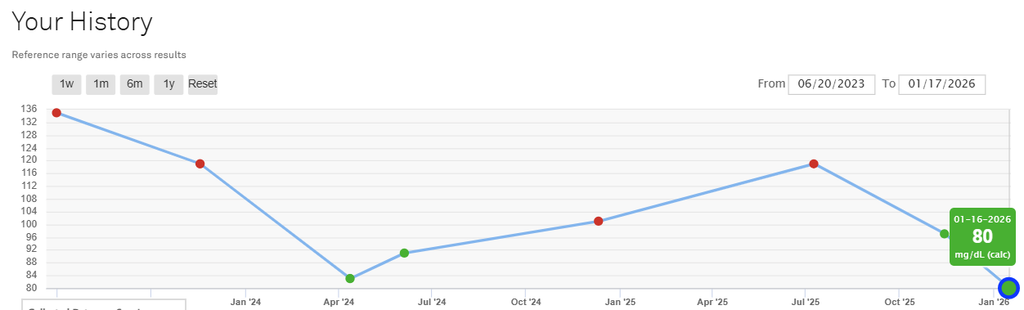
I was on the same statin dose and ate different food, and the result was a 39-point difference.
Once the “why” clicks, the “how” gets a lot simpler. I lay out the daily version in The Anchor Meal Plan.
Your one next step
Pull up your last lab report. Take your total cholesterol and subtract your HDL, and write that number down.
Then ask your doctor one question at your next visit:
“Does an ApoB test make sense for me?”
“Your cholesterol’s fine” might not be the whole story. The people waiting for you at the kitchen window deserve the whole story.
I’m not a doctor. This is education, not medical advice. If you take a statin, keep taking it unless you and your doctor decide otherwise.
References
- Sachdeva A, et al. Lipid levels in patients hospitalized with coronary artery disease: an analysis of 136,905 hospitalizations in Get With The Guidelines. American Heart Journal. 2009;157(1):111–117.
- Martin SS, et al. 2024 Heart Disease and Stroke Statistics: A Report of US and Global Data From the American Heart Association. Circulation. 2024;149(8)–e913.
- Borén J, et al. Low-density lipoproteins cause atherosclerotic cardiovascular disease: pathophysiological, genetic, and therapeutic insights. A consensus statement from the European Atherosclerosis Society. European Heart Journal. 2020;41(24):2313–2330.
- Varbo A, et al. Remnant cholesterol as a causal risk factor for ischemic heart disease. Journal of the American College of Cardiology. 2013;61(4):427–436.
- Sniderman AD, et al. Apolipoprotein B particles and cardiovascular disease: a narrative review. JAMA Cardiology. 2019;4(12):1287–1295.
- Cholesterol Treatment Trialists’ (CTT) Collaboration. Efficacy and safety of more intensive lowering of LDL cholesterol: a meta-analysis of data from 170,000 participants in 26 randomised trials. The Lancet. 2010;376(9753):1670–1681.
- LaRosa JC, et al. Intensive lipid lowering with atorvastatin in patients with stable coronary disease (TNT). New England Journal of Medicine. 2005;352(14):1425–1435.
- Cannon CP, et al. Ezetimibe added to statin therapy after acute coronary syndromes (IMPROVE-IT). New England Journal of Medicine. 2015;372(25):2387–2397.
- Sabatine MS, et al. Evolocumab and clinical outcomes in patients with cardiovascular disease (FOURIER). New England Journal of Medicine. 2017;376(18):1713–1722.
- Nicholls SJ, et al. Effect of two intensive statin regimens on progression of coronary disease (SATURN). New England Journal of Medicine. 2011;365(22):2078–2087.
- Esselstyn CB Jr, et al. A way to reverse CAD? Journal of Family Practice. 2014;63(7):356–364b.